
Most staffing firms don’t realize that the way their job board is set up is actively working against them.
Here’s the typical scenario: Your staffing firm has a main website at yourcompany.com with information about your services, industries you serve, your company story, and how great you are at what you do.
But when it comes to displaying job listings, many firms take one of two approaches.
Some host jobs on a subdomain, like jobs.yourcompany.com. It’s quick to implement, keeps everything under vendor control (not yours), and works perfectly with template designs. One size fits all. Others embed an iframe, which still has the same issues. An iframe will display content from the vendor’s owned servers on your site, but it’s siloed with no true data/design integration.
It may seem like no big deal, but it actually impacts your bottom line.
Your job board technology choice affects everything: SEO and AI search visibility, conversions, analytics, candidate experience, compliance, and profitability, which means that how you host your job listings can mean the difference between a thriving talent pipeline and lost opportunities.
And there’s a better way to do it.
What You Will Learn:
Discover why subdomain and iframe job boards dilute SEO, break analytics, and increase legal risks for staffing firms.
- How subdomains and iframes damage your SEO performance
- Why your analytics are broken, and ROI calculations are wrong
- How poor architecture drives candidates away
- The business, compliance, and legal risks you’re carrying
- What a modern, high-performing job board should look like
Understanding Subdomains and iframes
Before we dive into the problems, let’s clarify what we’re talking about.
What is a Subdomain?
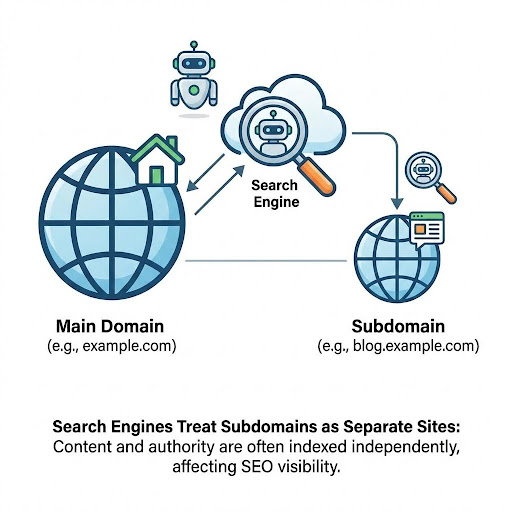
A subdomain is a prefix added to your website’s main domain name that creates a separate, distinct website. Instead of yourcompany.com/jobs, your job board lives at jobs.yourcompany.com.
Staffing firms often choose subdomains because it feels like a way to keep your job board separate but still part of your brand. Sometimes it’s vendor limitations, like your ATS provider only offers subdomain hosting. Sometimes it’s legacy systems and thought processes, AKA the “This is how we’ve always done it” problem.
What is an iframe?
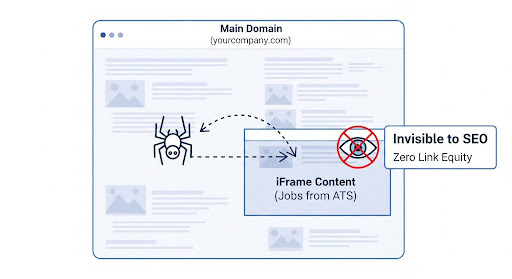
An iframe is an HTML element that embeds content from one website into a page on another website. Think of it like a window on your page that displays other content, similar to how you might embed a YouTube video in a blog post.
Staffing firms typically use iframes to embed job listings from third-party platforms or ATS systems directly onto their website pages. It feels convenient: your ATS handles the backend, and you drop the code onto your site. But search engines and AI tools see that embedded content as existing somewhere else entirely, or they don’t see it at all.
How Subdomains and iframe Job Boards Impact SEO Value
This is where the real cost becomes apparent. Let’s break down exactly what you’re missing out on.
Subdomains: Building Two Average Sites Instead of One Strong One
Search engines like Google often treat subdomains as separate websites from your main domain. When your jobs live on jobs.yourcompany.com, any SEO and AI search value they generate, like backlinks, traffic, and engagement, goes to the subdomain, not your main site.
It is possible for Google to see them as connected through strong relational content, links, and context, but building that connection is often a more lengthy and complex process than staffing firms can spend time on.
Diluted Link Value
When someone links to one of your job postings, which can happen in those popular job roundup posts that LinkedIn users share, that valuable backlink value goes to jobs.yourcompany.com, not yourcompany.com. Your main domain doesn’t benefit from this SEO equity. You’re essentially building two separate SEO profiles instead of one strong one.
Lower Search Rankings
And when you do that? You weaken your search rankings.
Your main site has built domain authority over time through content, backlinks, and trust signals. Jobs on a subdomain don’t inherit that authority.
Google is still an incredibly popular starting point for job seekers when searching for a new role. When you use a subdomain, your job postings rank lower, while your competitors with native job pages rank higher.
Fragmented Content Strategy
Websites with robust, valuable content inherently build trust in their niche.
If you have 500 job listings but they’re on a subdomain, your main domain shows fewer indexed pages. Fewer indexed pages equals lower perceived relevance and authority in Google’s eyes.
iframes: Invisible to Search Engines
If subdomains are problematic, iframes can be a disaster for SEO.
The harsh truth is that search engines cannot effectively index iframe content. And if they can’t be indexed, they don’t exist.
And if Google can understand them at all, those job listings embedded in an iframe exist on the third-party domain hosting them, which means no organic traffic to those jobs from search engines.
Case Study: Subdomain to Main Domain Migration
Challenge: A staffing firm was running into trouble with getting the traffic and attention they needed on their job postings, living on a subdomain.
Solution: After migrating to a native, SEO-optimized job board architecture with ATS Sync, Google started crediting its main domain for all that job content, boosting its overall domain authority. The job pages inherited years of accumulated SEO equity from the main domain.
90-Day Results:
- +20% jump in organic traffic to their entire site
- +69% increase in search impressions
- +68% more clicks to job postings
The Analytics and Attribution Breakdown
We’ve talked before about the importance of marketing attribution. Despite every executive wanting to know the ROI of a marketing effort, too many teams struggle to have the answer. So even if you could live with the SEO losses, the analytics problems alone would be reason enough to change course.
The Cross-Domain Tracking Problem
Given that Google Analytics mostly treats subdomains as separate websites, to track users moving from yourcompany.com to jobs.yourcompany.com, you need cross-domain tracking configured properly. While possible, cross-domain tracking can be complicated, fragile, and prone to breaking.
When that tracking breaks, the visibility into the candidate journey is all but lost. Here’s what happens when tracking breaks:
- Candidate lands on your homepage → tracked
- Clicks “View Jobs” and moves to jobs.yourcompany.com → tracking breaks
- Applies for a position → appears as direct traffic on the subdomain
You can’t see the full path from awareness to application, and you don’t know which marketing channels drive applications.
The iframe Attribution Black Hole
Iframes create similar issues as tracking breaks at the iframe boundary, and just like that:
- ROI calculations become pure guesswork.
- Your main site traffic looks lower than it actually is.
- Your job board engagement is siloed in a separate analytics property (or completely invisible).
Candidate Experience Suffers
It’s more than the technical work that suffers. The candidate experience is everything when it comes to job boards. When someone has to jump between domains or navigate in and out of iframes to learn about your company, search for jobs, and apply, you’re introducing friction and losing candidates.
Subdomain Experience Issues
When candidates click “View Jobs” and the URL changes to jobs.yourcompany.com, it feels like they’ve left your site. Because technically, they have, but there are even more hiccups that could leave them clicking away instead of clicking apply.
Design Inconsistency
Most subdomain job boards look different from the main website. Different navigation, different color schemes, different fonts. In a day and age where job board scams are prevalent, those differences matter, and professional candidates notice these inconsistencies, and they’re going to question whether to even apply.
Higher Bounce Rates
Anecdotally, we see bounce rates on subdomain job boards are typically 15-25% higher than native job pages. Candidates don’t trust the disjointed experience. They can’t easily navigate back to learn more about your company, and when the path isn’t clear, they leave.
iframe Experience Issues
iframes can create an even worse experience for job seekers.
Slow Loading
You’re loading a website inside a website. Every iframe adds loading time, and nowadays, candidates have zero patience for slow pages.
Mobile Disaster
Think about a time you went to a website that wasn’t mobile-optimized. Scrolling doesn’t work properly. Content doesn’t size correctly. Layouts break. The experience was probably so frustrating that you left.
Job seekers are no exception. Iframes are simply not mobile-friendly, and their use can alienate any job seeker using their phone to apply.
Business and Operational Risks
Beyond SEO and user experience, subdomain and iframe architectures can create real business risks.
Losing Control Over Your Own Content
Perhaps the most concerning issue: vendors can prevent administrative access to your subdomain job board. This is a critical business risk that many staffing firms don’t realize they’ve accepted.
Content Control Issues
It’s not a controversial statement to make: You should be in control of the content on your job board. If you’re working on a subdomain, especially through a vendor, it’s a very real possibility that you become dependent on them for any change, no matter how small.
When you want to update a job description “real quick”? You’re stuck waiting for vendor support.
Want to customize the look of your job board? Templatized subdomains that save cost mean no customization options to drive candidate experience and solidify brand awareness.
Want to test what works best for your audience? A/B testing is a valuable way to define the best practices for your job board, but without content control, you’re stuck working with whatever design you have on hand.
Data Ownership Questions
- Who actually owns the candidate data collected on that subdomain?
- Can you export it freely?
- What happens to your data if you switch vendors?
These aren’t hypothetical concerns. First-party data is gold for companies like staffing firms. When working on a subdomain or working with a vendor, you must keep ownership of your data.
Ultimately, when your job board exists on a vendor’s subdomain or in their iframe:
- You’re at the mercy of their platform updates and roadmap.
- Their downtime equals your downtime.
- Their design limitations become your limitations.
- Switching costs are high because you don’t control the underlying content or infrastructure.
You’ve essentially outsourced a critical business asset—your ability to attract candidates—to a third party.
Compliance & Legal Risks
Here’s where things get serious. You’re responsible for compliance violations even when you don’t control the platform.
ADA Compliance Risk
Is your subdomain job board accessible to people with disabilities?
- Is it screen reader compatible?
- Does keyboard navigation function properly?
- Is color contrast compliant with WCAG standards?
- Are forms properly labeled for assistive technologies?
If the answer is “I don’t know” or “I’d have to ask my vendor,” you have a problem.
CCPA/GDPR Data Privacy Risk
Going hand-in-hand with the data ownership concerns, data privacy regulations create additional exposure:
- Where exactly is candidate data stored?
- How is it processed, and who has access?
- Can candidates request data deletion as required by law?
- Is there a proper, compliant privacy policy in place?
What a Modern, High-Performing Job Board Architecture Should Look Like
Jobs as Native Content on Main Website
Every job should exist natively on your main domain. Not a subdomain, not an iframe—actual pages that are part of your website.
You get full SEO control, including proper schema markup, optimized meta tags and headings, control of page structure and content, and your job pages inherit the domain authority you’ve worked so hard to build.
Beyond the SEO benefits, when your jobs pages live on your main site, you get to bring your branding through every step of the candidate journey: seamless navigation between company information and job listings, and unified branding that builds trust.
Solutions, like ATS Sync, can automatically sync job data from your ATS (Avionté, Bullhorn, JobDiva, etc.) directly with your website CMS (Content Management System). You end up with fully branded, SEO-optimized, and mobile-responsive job pages and application flow seamlessly back to your ATS with no manual work from your team, all while you maintain control of your site, brand, ADA, and CCPA compliance, and candidate data.
Your candidates never experience a jarring transition from domain to subdomain, just a clear, intuitive path that lets them apply and lets you find the best person for the role.
And you can prove it all with unified analytics that help you track the candidate journey from click to close.
Measurable Business Benefits
Staffing firms that migrate to native job pages typically see:
- Higher search rankings for competitive job titles
- Better conversion rates from visitor to applicant
- Accurate ROI tracking for marketing investments
- Lower compliance risk through direct control
- Faster time-to-hire through better candidate experience
Summary: The True Cost of Subdomains and iframes
If your job board lives on a subdomain or in an iframe, you’re paying hidden costs every single day:
- SEO value flows to a separate domain instead of strengthening your brand
- Analytics are broken, making data-driven decisions difficult at best
- Candidates experience friction that drives them away
- You lack control over a critical business asset
- Compliance risks exist that you can’t properly manage
The technology choice that seemed convenient or inevitable is actually costing you rankings, candidates, and revenue.
But modern integration solutions, like ATS Sync, make it straightforward to move to native job pages on your main domain without disrupting your ATS workflow or requiring manual work from your team.
Ready to Take Control of Your Job Board?
If you’re ready to stop losing SEO value, fix your analytics, and create a candidate experience that actually converts, let’s talk about how native job pages can transform your staffing firm’s digital presence.
About the Author: Gordon Jackson
Gordon Jackson is the Chief Technology Officer at ClearEdge, where he helps clients roadmap technologies, integrate their systems, secure their hosting, and realize their marketing goals. Most recently, he has been perfecting ATS Sync, our solution that allows companies to integrate their ATS with a CRM and CMS to help staffing firms see the full candidate and client journey from click to close.
Job Board FAQs
Are subdomain job boards always bad?
Not always, but in many cases, they’re less than ideal. A subdomain may make sense if you’re running a separate brand or business unit that should have its own distinct identity and SEO profile. But often a subdomain creates more problems than it solves.
Why do ATS vendors push subdomains?
Most often, it’s due to convenience. From a technical standpoint, it’s much easier for an ATS vendor to give you a subdomain on their infrastructure than to integrate deeply with your website CMS.
Can I optimize an iframe for SEO?
Not really. You can optimize the page that contains the iframe, but the content inside the iframe itself still cannot be effectively indexed by search engines. If your job listings are in an iframe, they’re essentially invisible to Google.
Does moving to native job pages require changing ATS?
Not necessarily. Modern integration solutions, like ATS Sync, work with your existing ATS. Whether you use Avionté, Bullhorn, JobDiva, or another platform, the integration pulls job data and creates native pages on your website. Your recruiters continue working in the same ATS they’re familiar with.
How long does implementation take with ATS Sync?
We aim to get you all set up in about 3 – 6 weeks.
How often should job pages be updated for SEO?
For SEO optimization, the key is ensuring the initial setup includes proper schema markup, optimized meta descriptions, and good URL structure. Beyond that, fresh job postings and regular content updates signal to Google that your site is active and relevant.
Does moving to native job pages improve candidate conversion rate?
Typically, yes. When candidates have a seamless experience without domain changes or iframe issues, more of them complete applications.
Will rankings drop during migration?
Rankings typically stay stable or improve during migration if proper redirects are implemented. Every job URL from the subdomain should 301 redirect to its corresponding page on the main domain. This tells Google “this content moved here” and transfers the SEO value. Working with an experienced team ensures this is handled correctly.
How do native job pages improve reporting and analytics visibility?
With all content on one domain, Google Analytics tracks the complete candidate journey without cross-domain complexity. You can see exactly which traffic sources drive job views and which drive applications. You can calculate an accurate cost-per-application for each marketing channel. Attribution becomes clearer and more reliable.
Can native job pages support multilingual or location-based SEO?
Absolutely. Native pages give you complete control over URL structure, language tags for multilingual content, and location-specific optimization. You can create location landing pages (yourcompany.com/jobs/chicago), service-specific pages (yourcompany.com/jobs/healthcare), and other strategic content that would be impossible with a subdomain or iframe architecture.